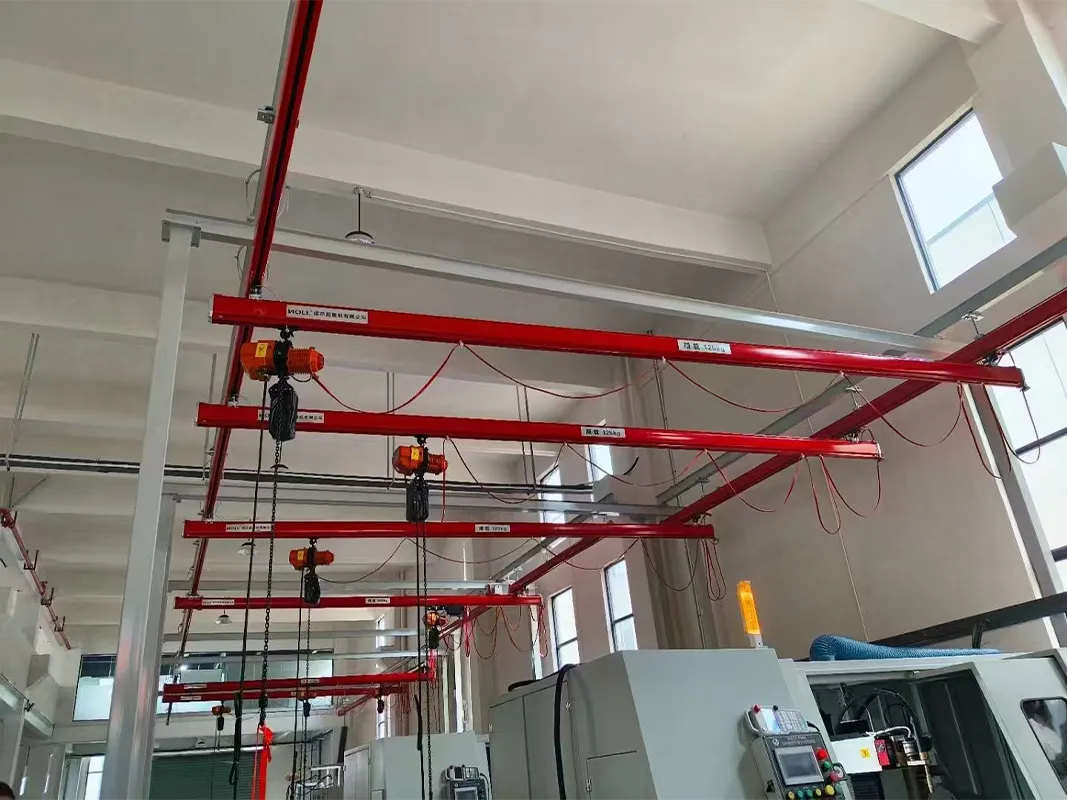
Underslung KBK multi-rail parallel flexible crane
Structural Composition
Suspension track:Multi-layered red KBK enclosed steel track, arranged in parallel, standard sections can be spliced together to extend indefinitely.
Hanging connectors:High-strength hangers and clamps fix the track to the underside of the roof truss/ceiling structure, with adjustable height.
Trolley:Built-in low-friction rollers drive the hoist along the track, making it easy to move.
Electric chain hoist: Orange body, equipped with black lifting chain and hook, responsible for vertical lifting.
Hook assembly:Forged hook with anti-slip latch, ensuring smooth chain loading and unloading.
Power supply system: Flat cable/sliding contact line power supply, wiring along the track, equipped with current collector.
Load marking:White load labels are affixed to the track beams, indicating the rated lifting capacity, and the load is traceable by zone.
Safety devices: Upper and lower limit switches, track end stops and buffers, overload protection, and power failure braking.
Working Principle
Each suspension rail constitutes an independent hoisting unit: the electric chain hoist completes the vertical lifting of the workpiece; the traveling trolley drives the hoist to move longitudinally along the rail; multiple rails are arranged in parallel, each covering a working zone, and the hoists at adjacent workstations do not interfere with each other and can work simultaneously. The operation is completed independently by personnel at each workstation through a hand-held flashlight, without the need for unified scheduling or the assistance of professional crane operators, reducing hoisting waiting time to zero.
Core Advantages
Parallel hoisting at multiple workstations:Multiple rails are connected in parallel and each rail is independent, allowing multiple workstations to lift simultaneously without queuing, which is a direct solution to the "race against time" dilemma.
Zero ground occupation:All loads are borne by the roof truss, with no supporting columns, and machine tool layout, forklift access, and personnel movement are completely unobstructed.
High space utilization:The track is laid in the "unused space" under the roof truss, without sacrificing any ground floor or mid-level headroom.
Modular and scalable:Standard sections can be spliced together, and tracks, number of tracks and workstations can be increased at any time, allowing for production line expansion without interruption.
Easy to push:The low-friction roller design requires little pushing force when fully loaded, and can be easily positioned by a single person. It is less labor-intensive than manual lifting and more flexible than a forklift.
Load zoning is traceable:Each rail is labeled with a load rating, making the rated load clear at a glance, overload risk is controllable, and safety management is standardized.
Safe and reliable:The hoist is equipped with upper and lower limit switches, overload protection, and power failure braking; the end of the track is equipped with a stop and buffer.
Low noise and clean operation:Low operating noise and no exhaust gas, suitable for long-term operation in indoor machine tool workshops.
Application Scenarios
Multi-station loading and unloading of CNC machine tools; hoisting of flange/disc/ring workpieces; parallel material transfer at multiple stations on assembly lines; workpiece transfer between machining processes; mold disassembly, assembly, and flipping; assembly of pump, valve, motor, and reducer components; equipment hoisting in maintenance workshops; light-duty hoisting in cleanrooms in electronics and light industry sectors; production lines where ground logistics channels must be kept unobstructed.
Recommended products
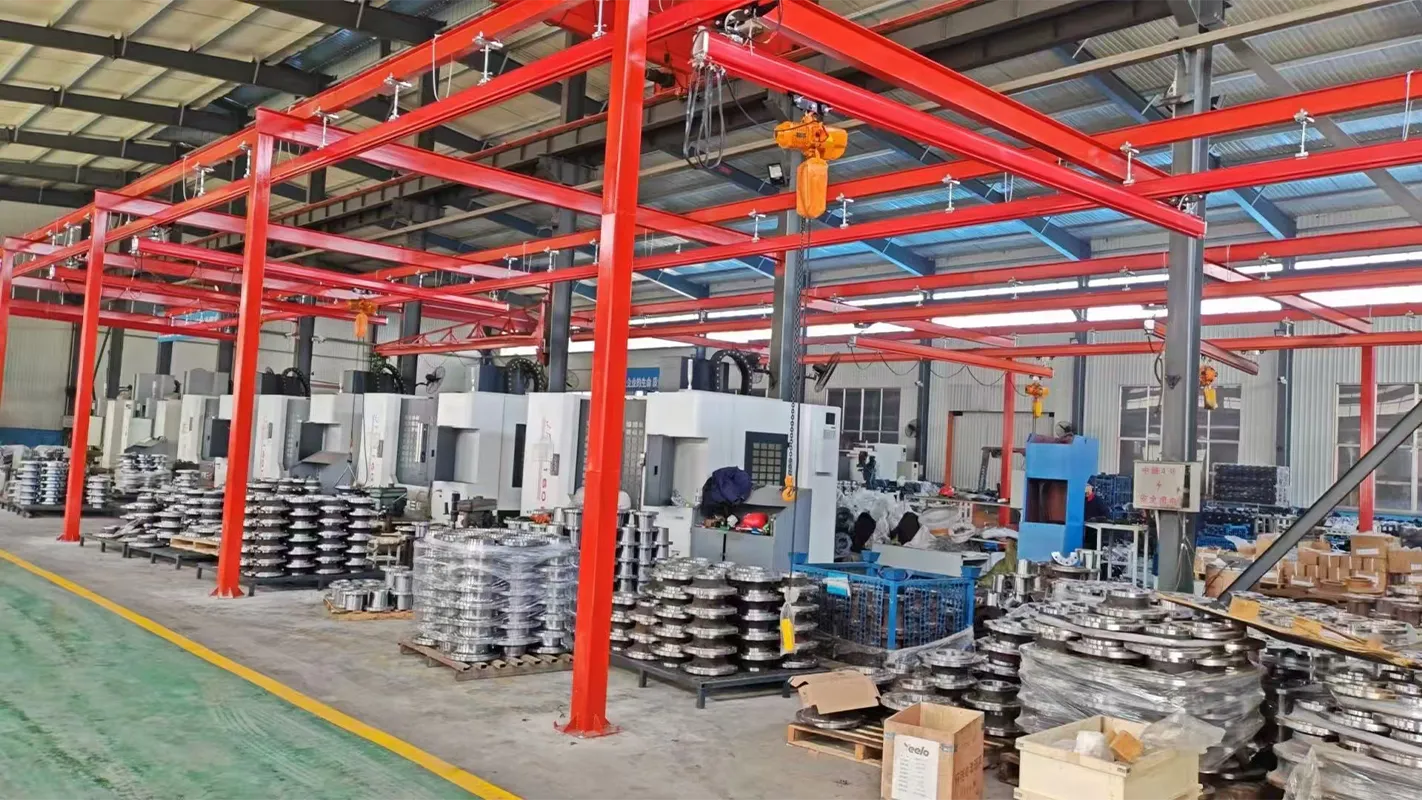
KBK multi-span covered crane with uprights
The entire set of equipment adopts a self-supporting structure with ground-mounted steel columns and red high-strength steel rails laid out in a crisscross pattern. It can span over multiple CNC machine tools to form a covered rail network. One crane can serve the loading and unloading operations of the entire group of machine tools, eliminating the need to configure separate hoisting equipment for each machine tool.
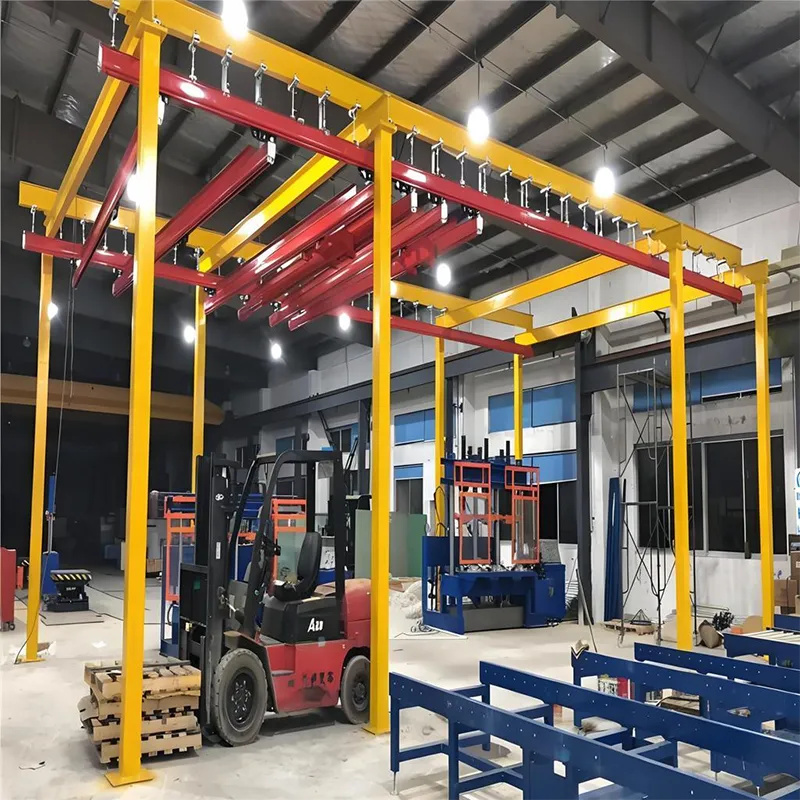
KBK Combined Rail Conveying System
The equipment utilizes a floor-mounted, self-supporting column structure, eliminating the need to rely on the facility's existing steel framework; it offers flexible installation and convenient assembly or disassembly. Featuring a red-and-yellow warning color scheme, it is highly visible and ensures safety while blending seamlessly into the workshop environment.
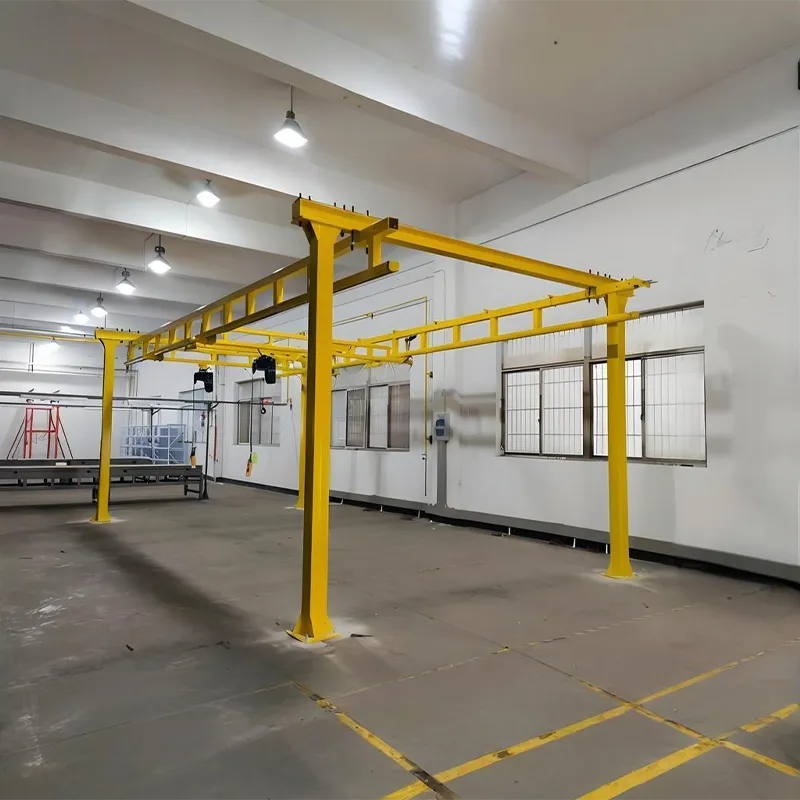
KBK monorail/single girder crane with upright support
It offers flexible installation and easy disassembly, and can be configured—based on the specific workshop layout—into various setups, such as linear monorail systems, rectangular single-girder coverage areas, or interconnected multi-station transport networks.


